

How to Identify Salesforce Licenses and Users
How Can Stakeholders Be Identified?
- Who are the external (like partners or customers) and internal (like staff) stakeholders?
- What kind of features will they require access to?
- Who will utilize Salesforce—internal or external?

How to provide consumers several kinds of license
- Which edition and product of Salesforce provides the necessary functionality?
- Which licensing schemes are available for the Salesforce products that have been identified, and how do they differ from one another?
- Which one should you designate for every kind of user or stakeholder?
- Additionally, consider licensing for your solution landscape’s non-Salesforce components.
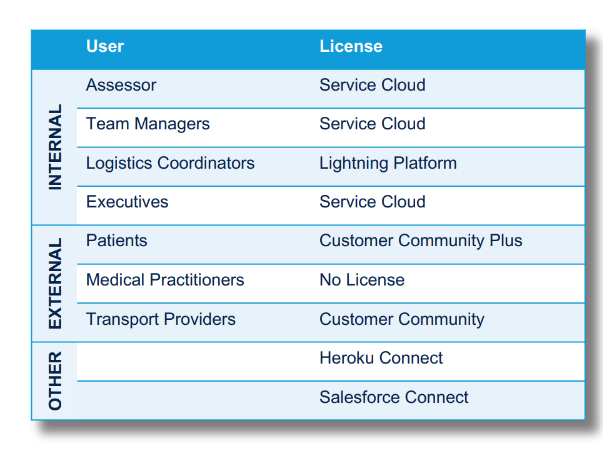
Why Service Cloud – Not Just Cases

Why Use Sales Cloud for Forecasting and Territory Management
Operations
The operations team is responsible for all HR-related issues, daily productivity enhancements, and market announcements.
Members of the internal operations team examine and approve announcements before their public publication when they are submitted.
Why Platform – Only Custom Object & Approval Process
Executives
Executives monitor global sales and service data.
Executives are interested in the revenue generated from hardware equipment sales, reseller service royalties, and trade royalties.
Executives want to learn more about service SLA infractions and quota attainment slippage.
The Reasons for Forecasting and SLA Reporting in Sales and Service
Brokers
Brokers are businesses that keep a collection of equities that they trade for their clients. They can operate USE-hosted hardware, submit service requests, and negotiate contracts.
USE would present a visual representation of the weekly case volume, assets held, and upcoming contract renewals to give brokers greater insight into their connection with USE.
Why Charting & Advanced Sharing with CC+
Customer Community Plus – Name User
Listed Entities
Companies that issue publicly traded equities are known as listed entities.
They must file announcements to notify the market of changes (such as quarterly revenue, a change in leadership, etc.) in order to comply with compliance standards.
A chart that displays the quantity of trades made for their stock over the last five, thirty, and ninety days is what listed entities want to see.
Why Charting & Advanced Sharing with CC+
Customer Community Plus – Name User
Individuals
As a result, USE has expanded to 600 brokers, 400 listed companies, and 3 million individuals, and it anticipates growing by 25% annually.
People must be able to register on LinkedIn, Gmail, and other websites with their email address and password.
Why CC: Basic Sharing & More Than 2 Million Members
Customer Community – Login Based
Resellers
Resellers who sell gear in data centers in collaboration with USE’s BDMs.
Resellers asked for a common platform that would enable them to add lines for their services and work with BDMs to create bids.
If USE is able to offer a common platform, resellers are willing to pay a 10% royalty on their services.
Why PC: The Creation of Opportunities
Partner Community – Named User
Website Visitors
The website is a custom page with static content and forms for visitors to fill out, including “I need help” and “Get in Touch.” At the moment, the forms are sent to shared email addresses. Employees at USE are griping about one another, saying that no one tells anyone if they have previously gotten in touch with someone. Additionally, USE is eager to provide a website login feature to the new system.
Why None – Web Forms and Login Button
No license required

Creating the System Landscape
System Landscape – Revisit the example
- Important elements (apps and systems)
- Existing and being deactivated is new
- Important Salesforce actors and licenses:
- The actor makes use of this license?
- One or more org
- Important third-party apps or systems
- How will the data be migrated (initial vs. ongoing)?
